Introduction
The word “tanking” has a way of making fans squirm. In Philadelphia, it became a religion – Sam Hinkie’s gospel of “Trust the Process”, years-long descent into basketball purgatory that promised redemption on the other side. The Sixers lost, and lost, and lost again, until Joel Embiid emerged as the chosen one.
And yet…no banner has ever hung. Embiid became an MVP, the Sixers became relevant, but the Process never delivered a championship. For all the losing, all the patience, all the pain, the payoff never came.
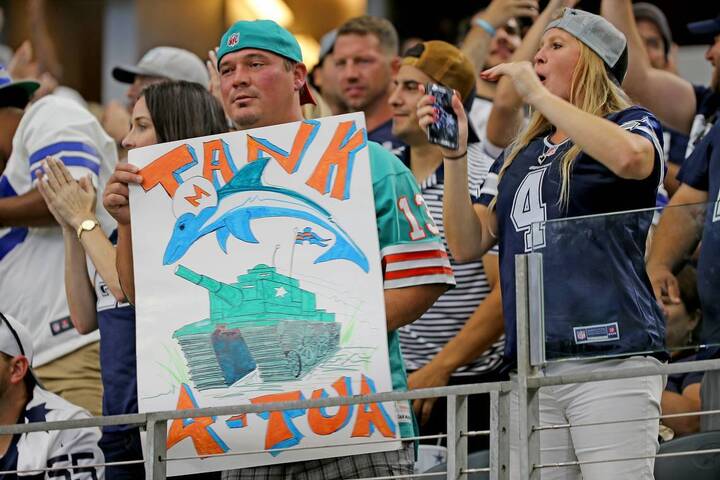
The NFL has had its own flirtations with surrender: “Suck for Luck”, “Tank for Tua”. Whole fan bases turned hopeless seasons into slogans, convinced that bottoming out would open the door to a franchise savior. No team embodied the peril of this thinking more than the Cleveland Browns. They bottomed out, stockpiled draft picks, and endured the bleakest of Sundays with a historic 0-16 season. American football isn’t basketball. Rosters are bigger, careers are shorter, randomness is crueler.
Some fans cling to the idea that winning culture is everything. That if you’re running a football team, you must guard it like a sacred flame. Tanking, in this view, isn’t just about draft picks and standings; it’s about poisoning the well, teaching players and coaches that losing is acceptable, branding the organisation with failure in its very DNA. There’s truth in that fear. A locker room without belief can rot from the inside out but carry that belief too far, and it becomes its own trap, an obsession with short-term respectability that can keep a franchise stuck in the middle forever.
Which raises the question: If even the NBA’s great experiment is yet to deliver the ultimate prize, what chance does tanking ever have in the NFL?
Potential Biases
Tanking, at least in theory, sounds simple enough. You sacrifice now to win later but football doesn’t live in theory – it lives in the mess of real owners, real front offices, and real impatience. Nothing kills a long-term plan faster than an owner who can’t sit still. The meddling, the snap decisions, the endless carousel of coaches and general managers – these are the forces that strangle franchises before any strategy, tanking or otherwise, has a chance to work.
That’s the cruel irony of the NFL. The league is designed for fairness. Salary caps, revenue sharing, the draft order – all of it is meant to pull the weak back toward the middle, to make sure nobody stays down for too long, yet some teams always do. Not because the system is broken, but because the management are. Bad management with a lifetime control turns a franchise into an “irrational actor”, a team that can’t help but trip over itself no matter how many advantages the league throws its way.
Look at the bottom of the standing in any given year. You won’t just see teams in transition, regrouping for another run. You’ll see organisations so dysfunctional they can’t get anything right – not free agency, not the draft, not even losing on purpose. These are the franchises that confuse incompetence with strategy, that call it a rebuild when it’s really just chaos. That makes tanking hard to study, because how does one tell the difference between a team that has chosen the basement and one that’s simply fallen into it.
The NFL doesn’t stop to sort out intent. Wins and losses pile up all the same. Football is zero-sum – every failure feeds someone else’s success. So while the bottom clings to futility and the top grows stronger. Stable ownership, patient front offices, smart decision-making – these are the forces that compound over time, the quiet advantages that turn good teams into perennial contenders. The truth is, the good often stay good and the bad often stay bad. Not because of tanking, but because of who’s sitting in the executive box.
Rant over let’s dig into the data.
Team Transiency
To measure team strength, we will use Pythagorean Win Expectation. It’s a concept borrowed from baseball, as a way of estimating how many games a team should have won based on the points they scored and the points they allowed.
Is it perfect? Of course not. No single metric ever is but it gives us a clean enough window into team quality to work with here. For each season, we lined up all the teams and ranked them from top to bottom. The top quarter of the league we call Great. The next slice down Good then Okay and finally the last quarter as Bad. Simple buckets that allow us to discuss success and failure in a way that translates across eras.
Eras matter. The NFL didn’t have true free agency before 1993. The league shifted again in 2011, when the rookie wage scale rewired how teams could build through the draft. We split the NFL into three eras. Before Free Agency, Before Rookie Wage Scale and the Modern NFL. Each one tells its own story about how teams rise and fall.
To begin, we look at year-to-year movement. In technical terms, we built a Markov transitional matrix for each era. It shows the probability of going from one state (say Good) to another (say Bad) from one season to the next. The questions the matrices answer are how often do teams actually stay where they are, and how often do they tumble or climb?
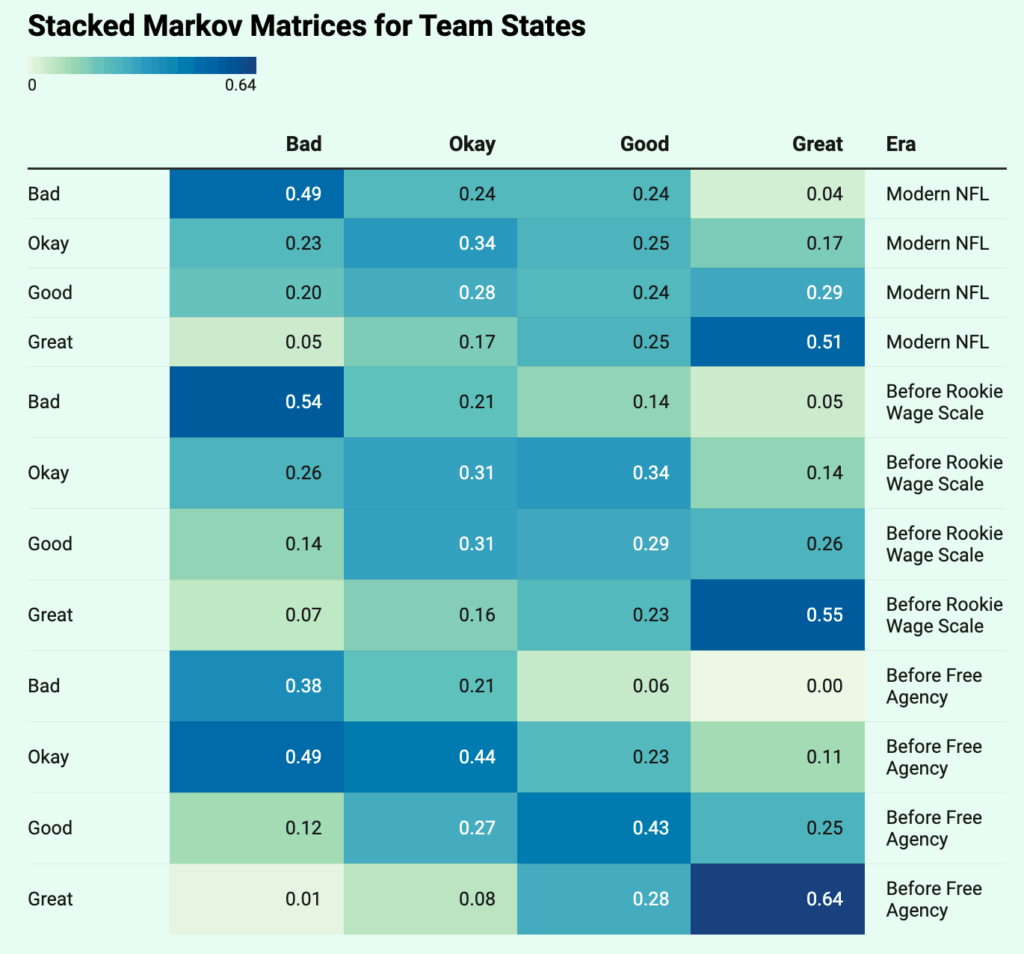
What does the data actually say? Put simply: if you’re a great team today, you almost never wake up bad tomorrow. In fact, a truly great NFL team only collapses straight into the cellar about 5% of the time.
This confirms common sense. The best predictor of greatness next year has always been greatness this year but here’s the twist – that link is weaker now than it’s ever been. In the modern NFL, being great doesn’t carry quite the same guarantee of staying great. Dynasties are harder to sustain, the climb back down comes quicker.
At the other end of the spectrum, the story is familiar and just as cruel. Bad teams stay bad. The leap from the basement to the penthouse in a single season is almost nonexistent. The extremes are sticky; the middle is where volatility lives, where teams can surge forward or slide back in the blink of an eye.
So if greatness fades and badness liners, is tanking nothing more than a fool’s errand?
Are the teams at the bottom destined to rot there forever? Not exactly.
Sign Up For Our Mailing List
Minimum Future Rank
Looking at how teams shift from one season to the next is useful, but it’s only part of the picture. Yes, most bad teams don’t magically leap into greatness in a single offseason – but that alone doesn’t prove tanking is a dead strategy. The more interesting question isn’t about instant turnarounds. It’s about trajectories.
What really matters is this: if a team bottoms out today, what’s the best version of itself it can realistically become in the years that follow? Does a miserable season open the door to future greatness, or just lock a franchise deeper into the basement?
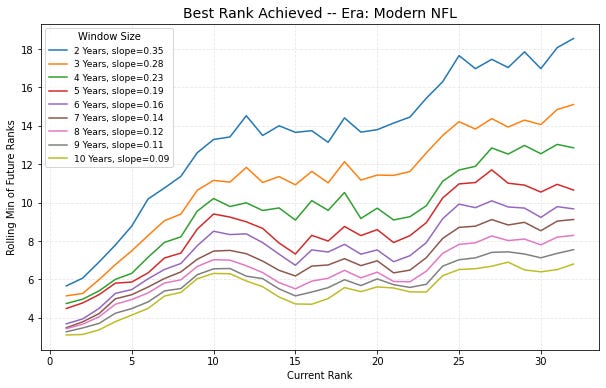
To get at that answer, we pulled every team’s finish by pythagorean rank and tracked how they performed over the seasons that followed. For each starting point, we looked at the best rank that team reached within the next two years, three years, five years, a decade and then averaged the results.
Think of the graphs below in this way: if your team ends a season as the X-th best team in the league, what’s the best they’re likely to be in the next stretch of years? In other words, how high can you reasonably expect a team to climb once it’s fallen to a certain level.
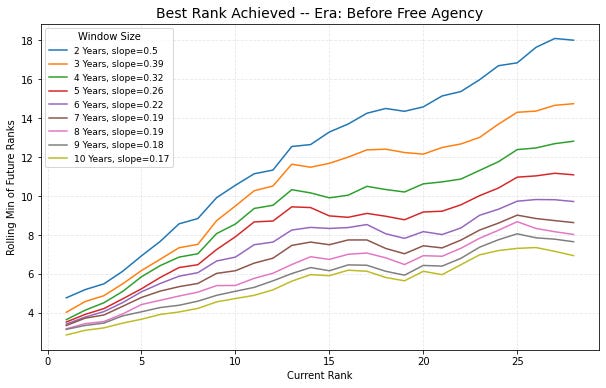
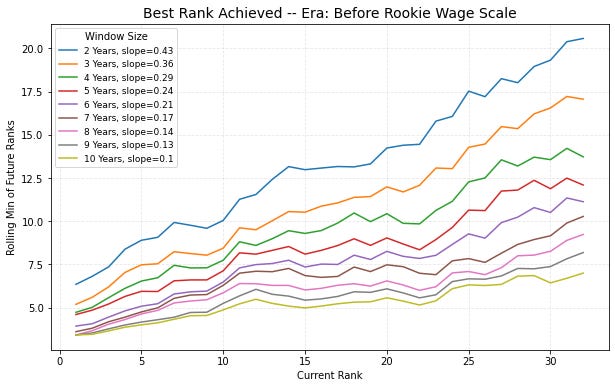
The first two graphs don’t offer many surprises. Without any external force dragging teams towards parity, the pattern is exactly what you’d expect: teams that are bad in a given year rarely touch the same heights as the ones who start off good.
Things are more interesting in the modern era. Take a 4-year window. Suddenly, the gap between a team finishing 10th-place is often caught in the trap of chasing a “winning culture”. They’re good enough to feel close, but not truly close at all – so they overspend, mortgage assets and claw at a ceiling that isn’t really within reach. Meanwhile, the 23rd-ranked team has less pressure to posture. They can rebuild, reset and sometimes leapfrog the pretenders stuck in the middle.
So let’s turn the question around. Instead of looking at peak ranks, let’s ask: how often does a team actually give itself a real shot at the crown? Call it a puncher’s chance at the title – finishing in the top 4. What proportion of teams reach that level in the years after their season ends, and how much does their starting point really matter ?
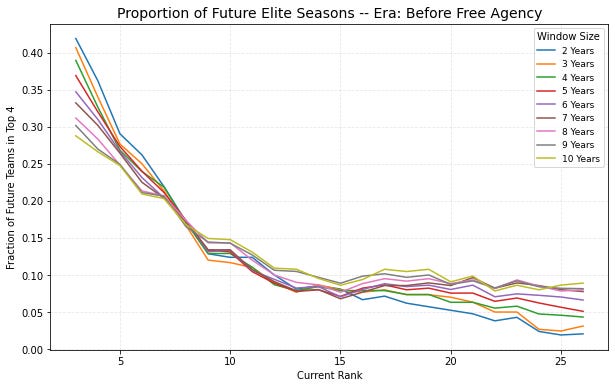
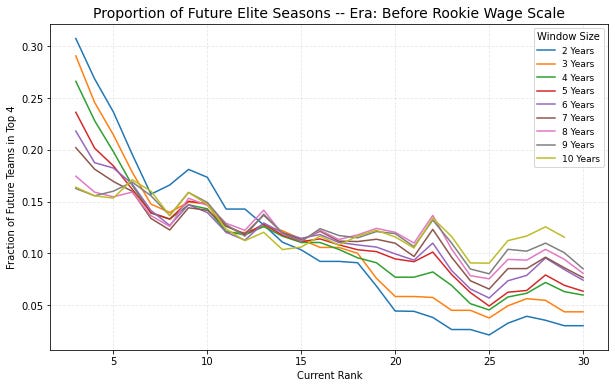
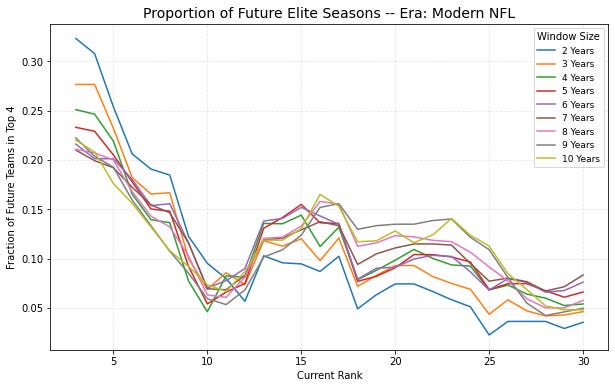
Again, the first two eras give us a clean, almost predictable story. But the modern NFL? That’s where things get messy. Right now, the numbers tell us something almost upside down: over a 4 year window, the team that finishes 10th in the league is actually less likely to field an elite squad than the ones that finished 30th. So much for “winning culture”.
We don’t make the rules here, we just follow the numbers. The numbers say there’s no more dangerous place to be than the middle. The teams that convince themselves they’re only “a play or two away” are the ones most likely to mortgage their future chasing a mirage.
If you think that’s abstract, let me leave you with something concrete. In the final week of the 2020 season. The Philadelphia Eagles are out of the playoff hunt, sitting at the bottom of their division. Nothing left to play for except draft position. What did they do? They pulled their starters, lost on purpose, and ignited a firestorm. Jason Kelce was furious, teammates were baffled, and the local and national media lit up with outrage. Take this quote:
“The Eagles’ brass deserve every ounce of disillusionment they’ll sense inside their locker room at the end of this year and the start of the next. Every little bit of resentment for the draft pick that was important enough to put their bodies on the line for. Best of luck to them pacifying a hive of pissed off veterans and their expensive former starting quarterback, who is also reportedly trying to muscle his way out of town. Whichever person orchestrated this ludicrous display (and it’s fair to wonder, given Doug Pederson’s job security, who above him on the chain signed off on this plan) should have to personally explain it to Jason Kelce’s face afterward, just two weeks after he stressed the importance of winning over everything regardless of circumstance. ”
You’d think Philadelphia buried itself for good in 2020. A team that lost its locker room, shredded its culture and openly tanked on national television. The sacred “winning culture” had been tossed aside for a single draft slot. And yet wasn’t that the logical move?
In the years that followed, that same Eagles team didn’t just survive. They made the playoffs four straight times. They went to two Super Bowls and won one.
Sign Up For Our Mailing List
Disclaimer: Data analysis isn’t about capturing every detail—it’s about uncovering meaningful patterns from what’s available. The data used in this study is both robust and thoughtfully selected, offering a reliable foundation for insight. While no dataset is ever truly exhaustive, we aim to be honest and provide insightful interpretation.