Introduction
By the time he reached his sixth major final at the 2024 Australian Open, Danii Medvedev had already banked 1,049 minutes on court. He started the title match at full throttle against Jannik Sinner, the less-tested finalist, pocketing consecutive 6-3 sets and dictating tempo. Then the match flipped. Sinner steadied, took the third, levelled the fourth, and closed in the decider, leaving Medvedev with a harsh milestone. The only player in the Open Era to lose multiple slam finals from two sets up.

By the end of the match, Medvedev had amassed 24 hours and 17 minutes on court – an Open Era single slam record – and that number quickly became the catch-all explanation for how a two-set stranglehold slipped away. The workload was brutal, back-to-back five setters before the final rarely conferred an edge. But does mileage alone account for the loss? Fatigue is a prime variable, sustained high intensity play with short recovery windows should erode physical and decision-making margins yet it isn’t destiny. Carlos Alcaraz set the previous record at the 2022 US Open and still finished the job against Casper Ruud, as such mileage matters but it doesn’t settle the match.
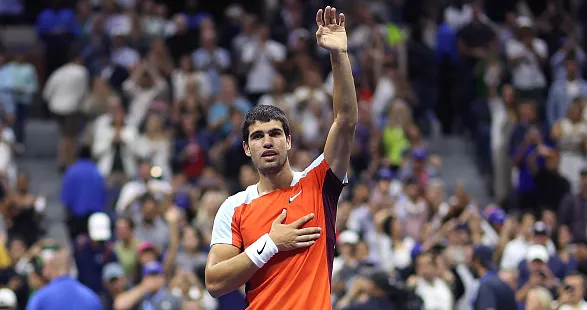
Set aside the talent gap for a moment. A cleaner lens is relative court time. Alcaraz logged heavy minutes at the 2022 US Open, but so did Casper Ruud – only 111 fewer minutes. In Melbourne, Medvedev shouldered a far greater load than Jannik Sinner – 349 minutes more. If both finalists arrive similarly taxed, the fatigue penalty may cancel out; when one carries a much larger workload, the edge likely tilts. That’s the hypothesis, anyway. To test this, we need breadth, not anecdotes. We pulled 30+ years of Grand Slam data to examine how absolute and relative tournament load shape a player’s chances in the final.
The Research Questions
In this article, we aim to answer the following questions:
- Does total court time leading up to a Grand Slam final impact a player’s odds of winning in the final?
- Does relative court time – that is, the difference between a player’s total court time and his opponent’s – affect a player’s odds of winning a Grand Slam final?
- If both total court time and relative court time are associated with odds of winning in the final, does the effect of total court time remain after controlling for relative court time?
The Data

Here’s the dataset. Each row is a finalist in a specific Grand Slam, with:
- The finalist’s name
- Their total court time before the final (predictor)
- Their final result (outcome), recorded as 1 for a win and 0 for a loss.
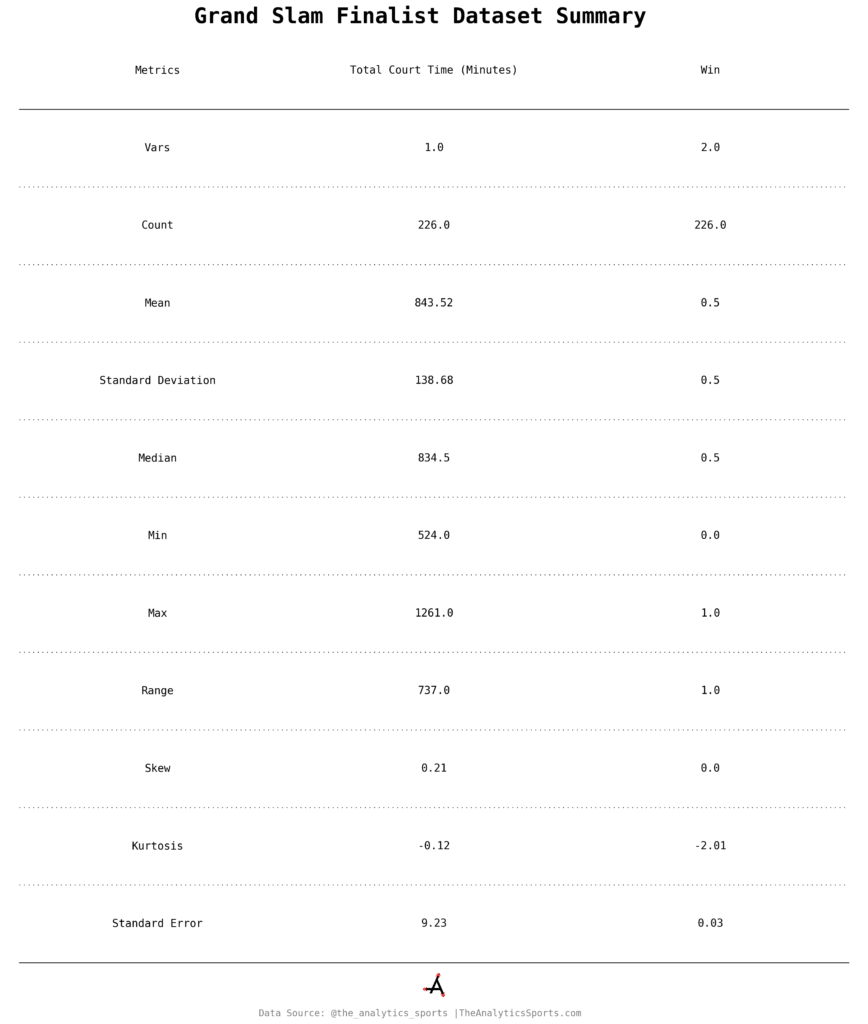
There are 226 rows covering 113 Grand Slams with 128 players draws, i.e. two finalist per tournament.
Below are the descriptive statistics for the predictor and outcome.
First, let’s see the relationship by comparing average total court time for winners vs losers.
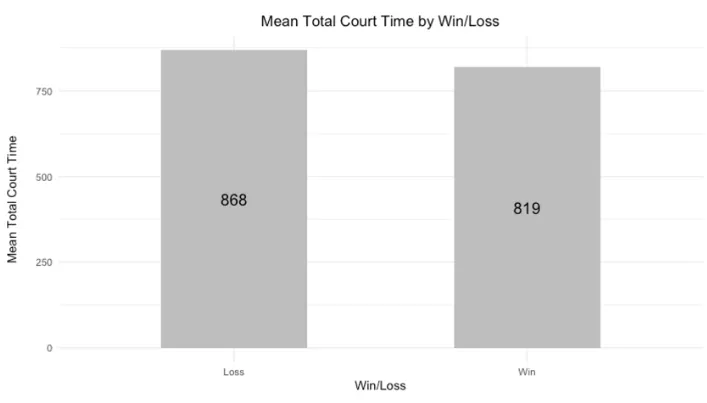
On average, players who lost had spent 49 more minutes on court than their opponents – early evidence that workload might matter but a mean difference doesn’t tell us the size or statistical significance of the effect. To answer this, we fit a model.
We used a logistic regression model. This is a statistical method used to predict the probability of a binary outcome. You can read more about it here.
Does total court time leading up to a Grand Slam final impact a player’s odds of winning in the final?
Win Probability ~ -0.002639 * Total Court Time + error
The model’s coefficient on total court time is -0.002639. In plain English, the number means more minutes before the final are linked to worse chances in the final. Each extra minute lowers the log-odds of winning by 0.002639.
Log-odds aren’t very intuitive, so let’s use odds ratios instead. Odd ratios (OR) tell us how the odds change for each unit increase in the predictor. An OR = 1 means no change and an OR = 1.5 means the odds are 50% higher.
The OR for our model is 0.997364. This means every additional minute spent on court, the odds of winning decrease by roughly 0.26%. This might seem like a small amount but say an additional 100 minutes spent on court, the odds of winning decrease by about 23.3%.
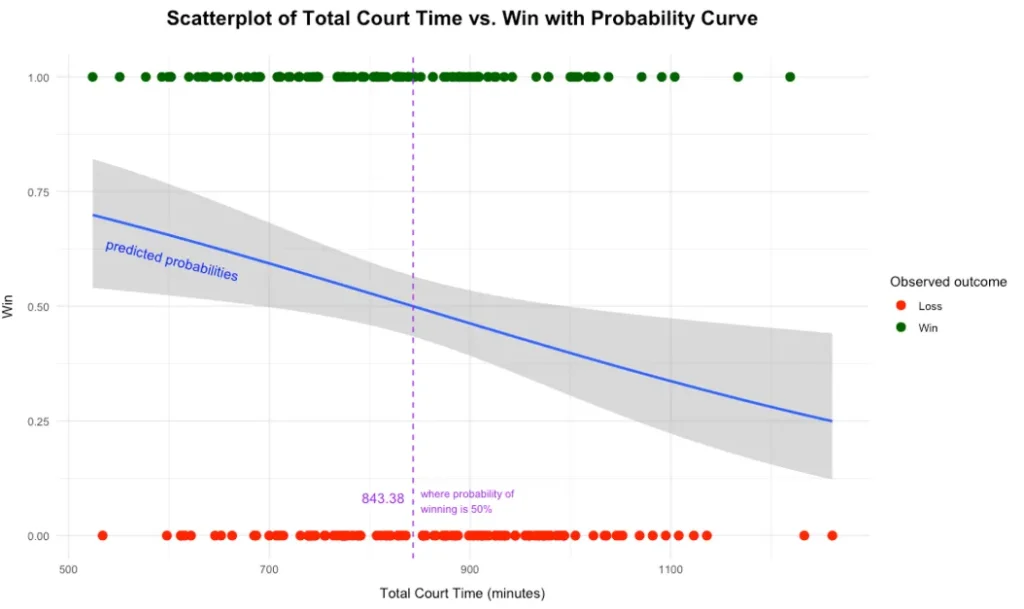
From the graph above we can identify the total court time required to have a 50% chance of winning. This is 843.38 minutes, circa 14 hours.
We’ve established an association between total court time and odds of winning a Grand Slam final. At a glance at the scatterplot, we can see a high degree of overlap between the green and red dots. This raises the question, “How strong is it as a predictor?” If all we knew was how long each finalist spent on court, how well could you call the result?
To test this, we built a ROC curve. You can read more about it here. AUC value of 1.0 means perfect predictor and an AUC value of 0.5 means the predictor is no better than a coin toss.
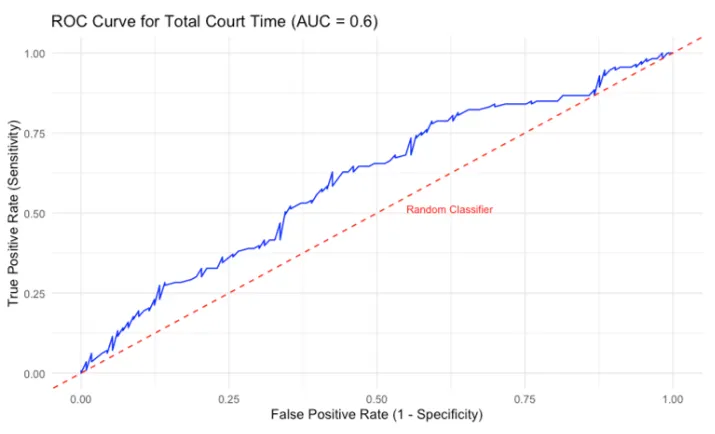
On the ROC chart above, the dotted red baseline is a coin-toss – an AUC value of 0.5. Our model clears that bar at an AUC value of 0.6, so total court time does separate Grand Slam finalists a bit better than chance but only a bit. We believe the fact that court time alone can inform predictions above chance is in of itself, noteworthy.
Sign Up For Our Mailing List
Does relative court time affect a player’s odds of winning a Grand Slam final?
Win Probability ~ -0.002905 * Relative Court Time + error
The model’s coefficient on relative_court_time is -0.002905, this is just a shade more negative than our previous model which had a coefficient of -0.002639.
Again we use Odds Ratio (OR), the OR for our model is 0.997099. This means every additional relative minutes spent on court, the odds of winning decrease by roughly 0.29%.
If we use the example of having 100 additional relative minutes, the odds decrease by 23.2%.
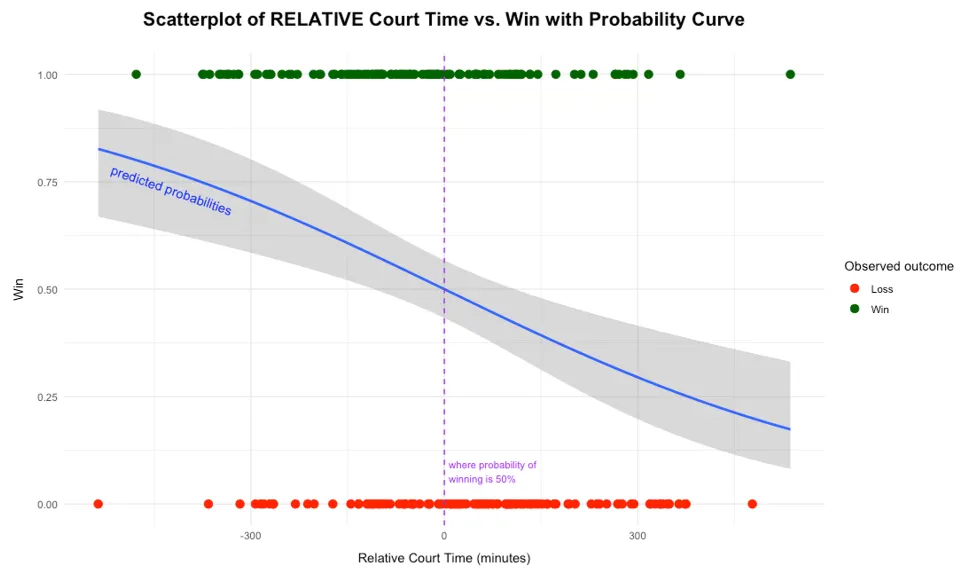
Back in the introduction, we floated a simple idea that it’s not just how many miles you’ve logged but maybe how many more you’ve logged than your opponent. Both Medvedev (Australian Open 2024 vs Sinner) and Alcaraz (US Open 2022 vs Ruud) arrived with marathon workloads, but Ruud’s game load sat much closer to Alcaraz’s whereas Sinner was noticeably fresher than Medvedev. If that gap really matters, a model built on relative court time should reward Alcaraz with a clear bump in win probability compared to the total court time model and this should also leave Medvedev comparatively worse off.
Let’s revisit the probability scatterplot for our two models but this time include the probability of the four players from the example above.
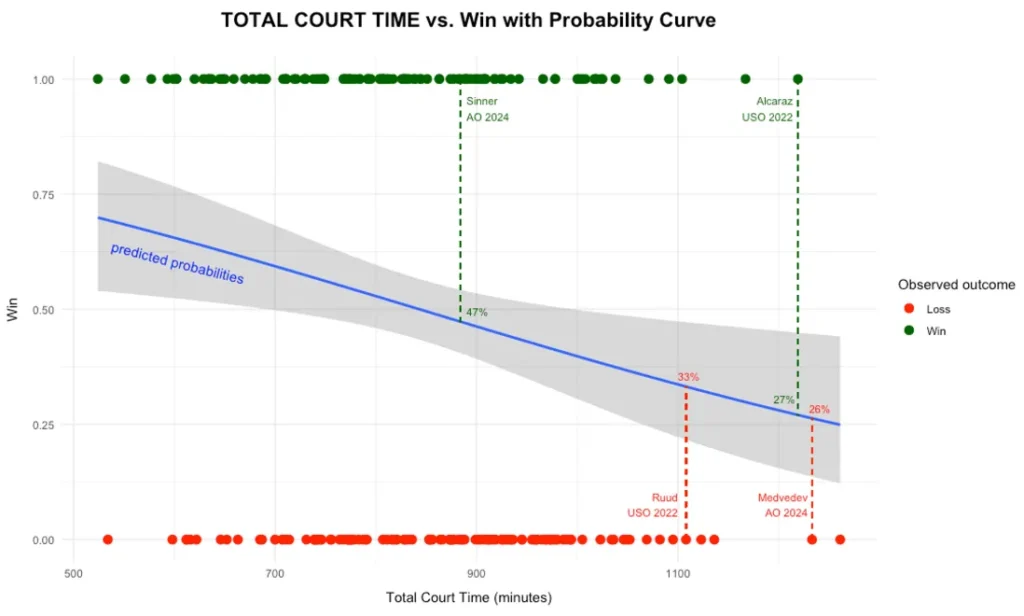
In the total court time model – where an opponent’s mileage doesn’t enter the equation – win probability is tied entirely to a player’s own court time. Through that lens, Medvedev is pegged at 26%, and Alcaraz is only a bit higher at 27%.
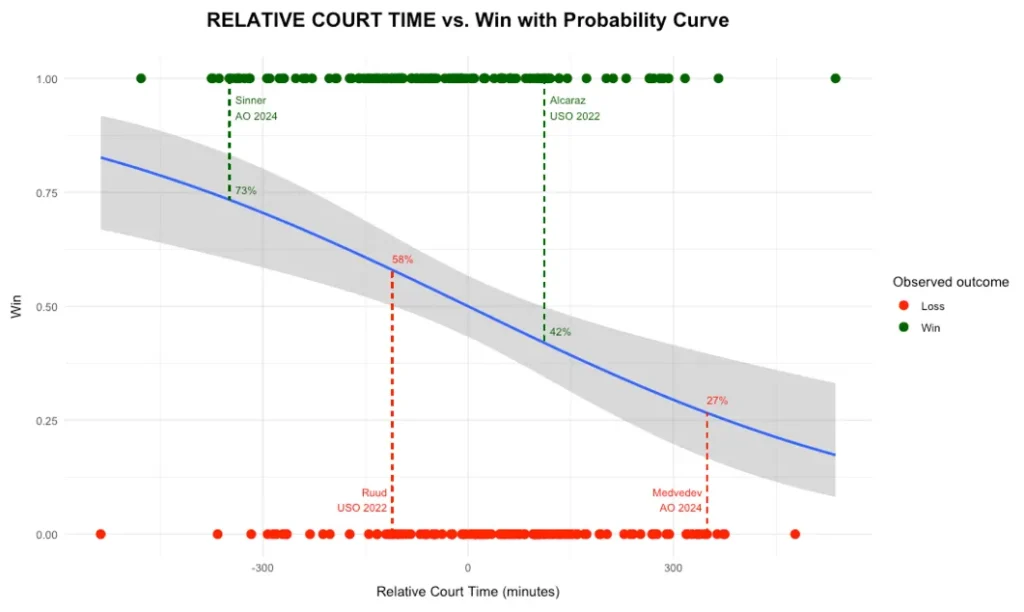
A look at the relative court time model and the picture changes. It only cares about the gap – not the total mileage – the tight Alcaraz-Ruud differential pushes Alcaraz’s win probability up to 42%, while Ruud, the slightly fresher player, retains the edge at 58%.
On the Medvedev-Sinner side, the contrast is sharper. Medvedev – burdened with one of the heaviest workloads in both total and relative terms – barely budges, holding at about 27%. Sinner, meanwhile, surges to 73%. Lined up against how those two finals actually unfolded, the relative-time model looks like the better fit, at least for these two examples.
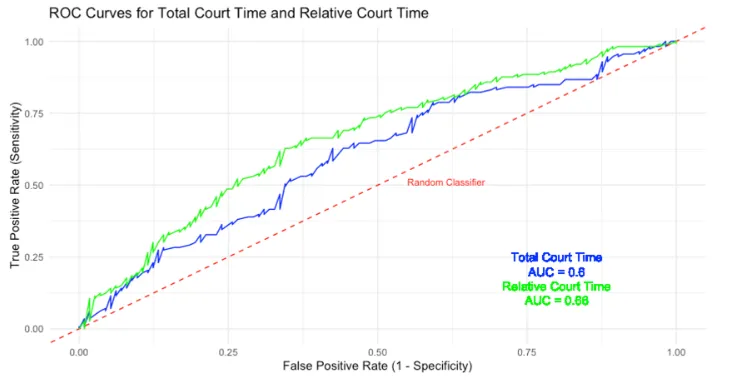
The relative court time model has an AUC value of 0.66. This confirms our intuitive idea from the examples of Medvedev-Sinner vs Alcaraz-Ruud.
Does total court time still matter once we account for the relative court time?
Win Probability ~ -0.000000000000000001364 * Total Court Time + -0.02905 * Relative Court Time + error
First the relative time coefficient is unchanged from the stand alone relative court time model. The twist is the total time coefficient. Once we control for the gap between players, its effect nearly vanishes. After we account for who is fresher relative to whom, the raw minutes logged add little if anything at all.
Takeaways
- Spending more time on the court before the final is linked to worse chances in the final, every extra 100 minutes reduces the odds of winning by about 23%.
- Relative court time, the extra minutes a player has compared to their opponent also hurts a player’s chances. For every additional 100 minutes a player has logged over their opponent, their odds of winning drops by about 25%.
- The effect of total court time all but disappears when controlling for relative court time.
Hold the opponent gap steady and raw mileage fades into the background. A player carrying 1000 minutes has roughly the same winning odds as one with 600 minutes if their difference vs the opponent is identical.
Of course, that’s a ceteris paribus thought experiment. Real tennis never holds everything equal. Some additional variables could sharpen the model such as age. With all that being said, the evidence is quite convincing. The relative court time impacts the odds of winning in a Grand Slam final. The next time your favourite player slogs through an unexpected five-setter in the second round, you better hope their eventual counterpart on the other side of the draw is having just as rough of a time.
Sign Up For Our Mailing List
Disclaimer: Data analysis isn’t about capturing every detail—it’s about uncovering meaningful patterns from what’s available. The data used in this study is both robust and thoughtfully selected, offering a reliable foundation for insight. While no dataset is ever truly exhaustive, we aim to be honest and provide insightful interpretation.