Introduction
Last season has brought hints of a tactical shift away from the current footballing norm that has long been shaped by Pep Guardola’s approach – one that emphases control, structural discipline, suffocating the opponent with possession and territory, backed by the five-man rest defence. Now teams like Iraola’s Bournemouth are breaking the mould, the poster boys of the new “counter-culture”. They play fast, fearless, high-risk football and it worked. The Cherries achieved their best league position and points total last season. Even Guardiola has taken notice, describing Bournemouth’s style as “Modern Football”.
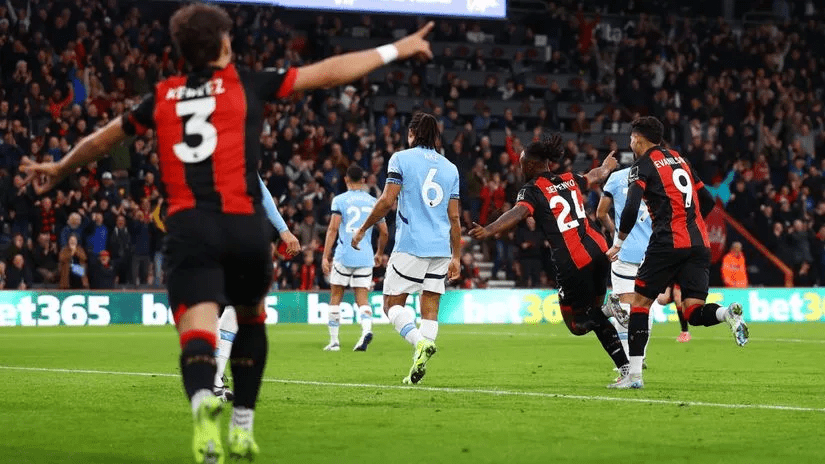
A contrast in style isn’t a new thing, back in the 2010s, Guardiola and Klopp stood at opposite ends of the tactical spectrum. Klopp’s Dortmund and early Liverpool teams thrived on pace and aggression, powered by relentless “gengenpress”. Klopp described his style as “Heavy Metal Football”. Meanwhile, Guardiola’s Bayern and Man City sides embodied controlled possession and methodical build-up. This tactical dichotomy is captured brilliantly in a Tifo Football video, which is well worth a watch.
The Klopp-Guardiola dynamic illustrates how, at top-level football, all roads often lead to control. Klopp’s Liverpool team gradually evolved into a positional team, focusing more on controlling games and picked up lots of silverware in the process. That shift felt natural, dictating tempo and reducing variance naturally benefits teams with superior talent. A formula Guardiola has repeatedly proven successful, particularly in league campaigns.
Put simply, control has been the dominant tactical approach in recent times. But it also raises a question: “is there a ceiling to chaos-ball”? This kind of high-risk, high-reward style tends to work best for underdog teams, who use it to disrupt the flow, cause problems, and level the playing field. The real challenge comes when those teams grow in quality – can chaos still carry them forward, or does it eventually hold them back?
What is Chaos-Ball?
By now, most of us are well-acquainted with the “control” style of football: organised positional play, slow and methodical build-up, wide play to stretch the pitch, but ultimately a focus on breaking through the middle and working the ball into the box.
The “chaos” style doesn’t have a strict definition, but we describe it as built around intense pressing, risky forward passes, overloads in wide areas, and plenty of physicality. Bournemouth are a clear example of this philosophy. They play with direct intent and press high in a man-to-man setup, all with the goal of disrupting their opponents’ rhythm and preventing them from ever taking control. The other hallmark of The Cherries approach is how quickly and frequently they attack space, players are constantly making runs in behind and they’re more than willing to overload the box when the moment is right.
A key difference between Bournemouth and a side like Manchester City is their appetite for risk in wide areas. Bournemouth’s players are encouraged to be bold. Milos Kerkez, now a Liverpool player is a dynamic left-back frequently bursting forward on overlapping runs, and wide players are given the freedom to take on their man. In an interview with The Independent, manager Andoni Iraola summed it up best, he wants his players to “risk a little bit in the dribbles” and, if they “don’t have a teammate ahead, forget about pattern, just drive the ball and try to force things to happen. I want him to attack first”. It’s a sharp contrast to City, where players like Jack Grealish often prioritise ball retention, choosing to pass back rather than gamble with a take-on maintaining control over chaos.
Bournemouth’s off-the-ball structure is where their chaotic identity really shines through. Thanks to some data from markstats. They led the Premier League last season in forcing the lowest opposition pass completion rates – both in build-up and overall. They also cause the most turnovers near the opposition’s goal, which speaks volumes about their intensity. It’s fair to say they’re one of the best pressing teams in the English Premier League. At the Analytics Sports, we believe Arsenal have the edge over Bournemouth in terms of overall pressing quality, but what sets the Cherries apart is how relentlessly they apply it. Iraola’s side presses with full commitment, rarely letting up, unlike the Gunners, who are more willing to drop into a compact block when the situation calls for it.
Suffice to say “Chaos-Ball” is all about aggressiveness. The real difference between chaos and control comes down to how much risk a team is willing to take, both when they have the ball and when they don’t.
How To Categorise The Two Styles
We want to explore how different teams fit into the chaos-control spectrum. We will use machine learning to help with this by collecting a variety of team statistics from the 2024/25 season to observe where teams lie on this spectrum.
We think team styles can be broken down along two main axes:
- Risk Appetite and Aggressiveness – teams that play direct and fast, pressing high and taking constant risk versus teams that are cautious, avoiding unnecessary risks, and prioritising structure over spontaneity.
- Possession Quality – teams that don’t want much possession or waste it when they have it versus teams that move the ball with intent and regularly create chances in dangerous areas.
Given the two axes, this means we will have four quadrants, they are:
- High Possession, High Aggression
- High Possession, Low Aggression
- Low Possession, High Aggression
- Low Possession, Low Aggression
It’s important to note that these axes are not direct indicators of team quality. Though naturally, better teams often display stronger possession traits. That said, stylistic placement doesn’t always align with success. Rafa Benitez’s Liverpool would likely fall into the low possession, low aggression quadrant, yet achieved success. Conversely, Erik Ten Hag’s Man United sides might fit into the high possession and high aggression quadrant, even though their overall performances have often been poor.
To carry out this analysis, here at the Analytics Sports we pulled together stats for every team in the top five European Leagues from the 2024/25 season, with the aim to identify metrics that best capture the ideas of possession quality and risk/aggression. Below is a breakdown of the metrics included and a brief justification for each:
- Possession & Passes Completed – simple measures of how much of the ball a team has during games.
- Progressive Passes/Carries – higher volumes reflect better possession quality.
- Pass Completion % – tell us about passing quality, but also reflects how risky a team’s passing choices are.
- Short & Long Passes – a good contrast: more short passes usually means a possession-focused team, while more long passes suggest directness.
- Passes in Opponent’s Final Third & % of Passes in Opponent’s Final Third – these show territorial dominance. A high % with few total passes may point to a direct, attack-first mindset.
- Touches in Defensive vs Attacking Third – helps us understand where on the pitch teams are spending their time on the ball.
- Take-Ons Attempted – more takes-on equates greater attacking intent and risk-taking with the ball.
- Aerial Duels – teams that play more direct often rely on long balls and contest a lot in the air.
- PPDA & OPPDA – useful for measuring how aggressively a team presses (PPDA), and how much pressing they face (OPPDA).
- xT & xTA (Expected Threat) – these show how often a team is creating danger or allowing it. A good measure of territorial control.
- Build-Up Pass Completion (Own & Opponent’s) – indicates how well teams play out from the back and how disruptive they are when pressing.
- Defensive Line Height (Own & Opponent’s) – shows how high or deep teams defend, which ties into both risk and compactness.
- Dangerous Losses (Own & Opponent’s) – reflects how often teams lose the ball near their own goal, and how well they force those errors in others.
Sign Up For Our Mailing List
Methodology
To make it easier to compare styles, we used a method called Principal Component Analysis (PCA). You don’t need to know all the details, but basically, PCA takes a group of different statistics and combines them into just two key numbers that still capture most of the important information. Think of it like making a complex dish with lots of ingredients. PCA helps boil it down to just the two main flavours that matter most.
The two numbers are called components and represent the biggest patterns in the data:
- The first component (PC1) captures the strongest trend.
- The second component (PC2) shows the next biggest trend that’s completely different from the first.
This makes it easier to spot patterns when we plot the data on a graph.
Possession Quality (PC1) – teams scoring high on PC1 generally show:
- Higher possession
- More progressive actions
- Better build-up passing
- Face less aggressive pressing
- Strong pressing
- Fewer aerial duels
This suggests PC1 represents a possession-oriented, methodical build-up style with technical competence.
Aggressiveness (PC2) – teams scoring high on PC2 typically display:
- More passes in the opposition third
- More dangerous opposition losses
- Better build-up passing
- More aerial duels
- Lower build-up pass completion
- Strong pressing
- Face more aggressive pressing
This suggests PC2 represents a more direct and aggressive style with more long, aerial balls and lots of high pressing.
As we can see, the PCA has simplified the data into two clear axes, which match our initial hypothesis of chaos and control.
Results
We plot the results on the scatter chart below. PC1 is shown on the x-axis, teams further to the right tend to be stronger in possession, while those on the left are weaker on the ball. PC2 is on the y-axis, teams higher up play with more aggression, while those lower down adopt a more conservative approach.
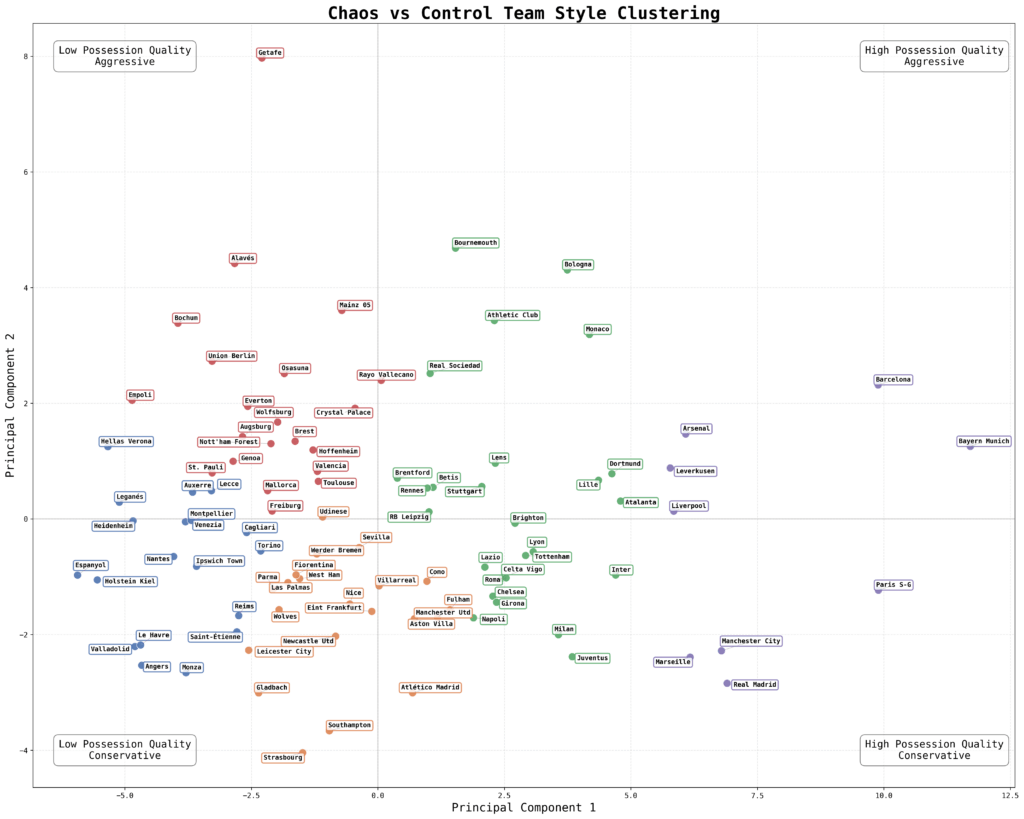
Each team on the graph is shown in a different colour based on groupings identified using machine learning. This helps us highlight clusters of teams with similar playing styles.
The Purple Cluster
This group mostly includes the crème de la crème of European football teams plus Marseille. The key trait among this group is excellent possession play. Bayern, PSG and Barcelona really stand out, not surprisingly all three teams won their domestic leagues last season. However, we see some variation in aggressiveness, the likes of Real Madrid, Marseille and Man City lean towards a more conservative approach, while Arsenal, Barcelona and Bayern appear more aggressive.
The Green Cluster
This cluster includes teams that are fairly competent in possession, though not exceptional. Many of them adopt a more aggressive approach, with Bournemouth standing out as the most aggressive in the group and second most aggressive across all of Europe – which certainly passes the eye test. Most of the others sit closer to the centre, which suggests a lack of clear playing identity. A surprise inclusion is Tottenham in the conservative quadrant.
The Orange Cluster
This group features teams that range from average to poor in possession and tend to play quite conservatively. Strasbourg top the chart as Europe’s most conservative team, with Southampton not far behind. Other notable inclusion are Atletico Madrid, Aston Villa, Man United, and Newcastle. Newcastle is an interesting inclusion alongside Atletico Madrid as Eddie Howe reportedly spent time at their training ground during his sabbatical before taking over at Newcastle.
The Blue Cluster
This cluster consists of teams with poor possession quality and a more conservative playing style. There’s not a lot to say, apart from the fact that Ipswich Town is the only Premier League side here.
The Red Cluster
This set captures teams that play with high aggression but lack strength in possession. A notable inclusion in this group is Jose Bordalas’ Getafe, a side renowned for its highly direct and aggressive approach. Their position on the chart serves as a strong support of our methodology. Nottingham Forest, Everton and Crystal Palace also fall within this group.
Pep Guardiola’s Man City struggled last season, Liverpool won the English Premier League and embraced a much more direct approach compared to City. The fair question to ask is whether “chaos-ball” has a limit. Like we touched on before, can a team really keep up that level of intensity all season and still come out on top? Maybe Liverpool struck the right balance last season, adapting their style to the current game situation. One thing is for sure, the beautiful game would do better to embrace chaos more often.
Sign Up For Our Mailing List
Disclaimer: Data analysis isn’t about capturing every detail—it’s about uncovering meaningful patterns from what’s available. The data used in this study is both robust and thoughtfully selected, offering a reliable foundation for insight. While no dataset is ever truly exhaustive, we aim to be honest and provide insightful interpretation.