Introduction
“Monachopasis” – a word that captures a subtle yet persistent feeling of not quite belonging. It’s a fitting sentiment for the story of many newly promoted clubs. In both the 2023/24 and 2024/25 seasons, all three promoted teams were immediately relegated, returning to the Championship after just one year. It’s hard not to imagine fans, players and club executives sensing that same unease during their brief Premier League stays.
A growing hum within football media has begun to ask the obvious question. “Why are promoted sides struggling so much to survive in the top flight?” The term “yo-yo clubs” has gained traction – used to describe teams that are too strong for the Championship, yet seemingly not equipped to compete in the Premier League, creating a promotion, demotion, promotion, demotion cycle. Many pundits attribute this to an inability to attract top-tier talent or a stubbornness to evolve tactically at the next level.
In this article, we’ll explore and attempt to quantify the true performance gap between the Championship and the Premier League.
Mind the Gap

The approach taken is to compare the underlying performance metrics of promoted teams during their Championship promotion campaign and their first season in the Premier League.
We look at expected goals (xG) for and against for each team, and consider the total expected goals of the leagues in their promoted seasons to put their own expected goals number in comparison to the rest of the teams. We then use an average change in their expected goals value during their first season in the premier league to estimate a performance tax.
The main issue with this method is expected goals as metric only dates back to 2017, with only 3 teams promoted a season. This means we are working with a small sample size.
The Championship Numbers
When we look at the expected goals difference (xGD) of every side promoted from the Championship since the 2016/17 season, a few teams stand out from the rest. On average, these promoted sides posted an xGD of +0.52. That might seem underwhelming – especially in the context of the Pep Guardiola era at Manchester City, where a +1.00 xGD is the norm.
The Championship is a different beast. It’s fiercely competitive, and the league’s most dominant teams are promoted each year, making it difficult for any one side to maintain control over multiple seasons. On top of that, this average includes playoff winners – teams that can finish as low as sixth yet still earn promotion. Naturally, these sides tend to be weaker on paper, which brings the overall average down.
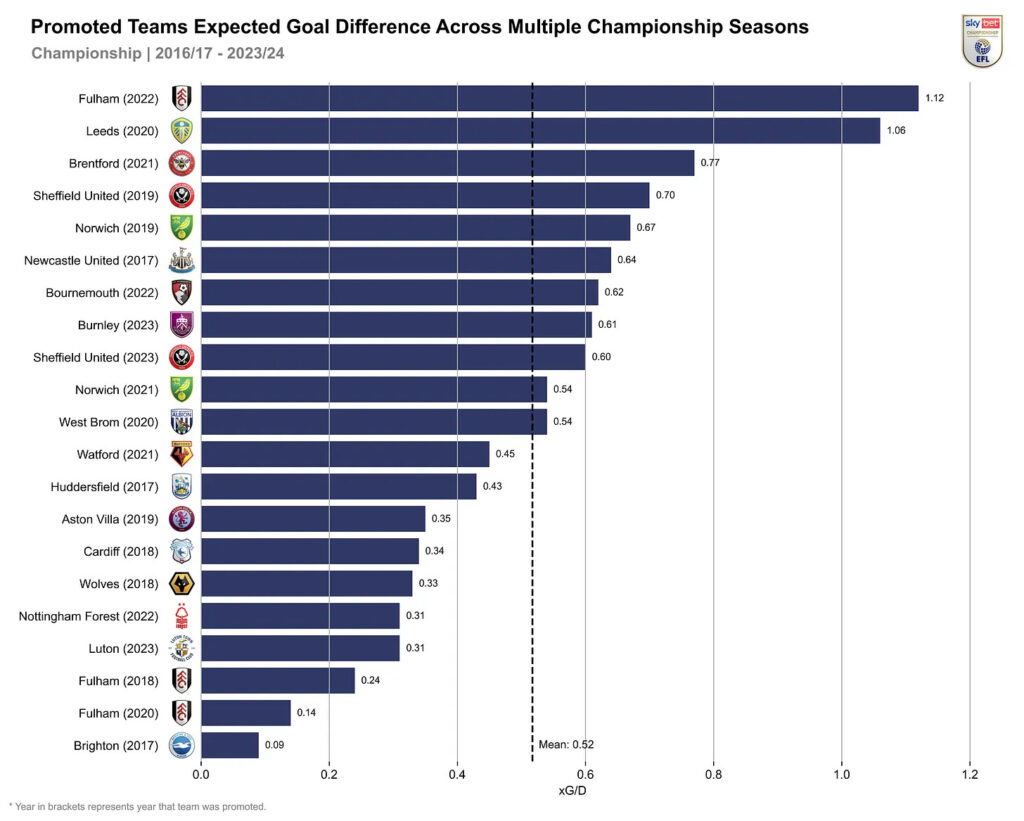
Among all the promoted sides, two teams stand head and shoulders above the rest in terms of underlying performance. Marco Silva’s Fulham in 2020 and Marcelo Bielsa’s Leeds in 2020. They’re the only teams in the dataset to post an expected goal difference (xGD) of over +1.00 per game – an elite benchmark more commonly associated with top-tier Premier League sides.
These two sides stand out to us for different reasons. Bielsa’s Leeds were electrifying – his arrival felt like a gift from the footballing gods. Their relentless, aggressive style and direct attacking play made them one of the most thrilling teams to watch in recent Championship history. Fulham, on the other hand, were powered by the sheer dominance of Aleksandar Mitrovic, who shattered goal-scoring records with an incredible 43 goals in a single season. Both teams imposed themselves on the league in a way few promoted sides have managed to replicate.
Brighton’s promotion in 2017 under Chris Hughton stands out – but for very different reasons. Given the club’s current reputation for outperforming expectations and maximising limited resources, We were surprised to see how underwhelming their underlying numbers were at the time. It’s easy to look back and assume they dominated the Championship, but in reality, Tony Bloom’s long-term vision was still taking shape. Hughton’s Brighton were pragmatic rather than expansive, and many of their early signings failed to make an impact. They finished second with 93 points – an impressive feat considering their expected goals difference was closer to mid-table than top of the Championship.
The Premier League Numbers
Next, let’s look at how these teams fared after making the leap to the Premier League. As expected, there’s a clear drop in performance. On average, their expected goal difference per game falls to -0.53 – over a full goal lower than during promotion-winning campaigns. The step up in quality is stark, and even the most dominant Championship sides often struggle to assert themselves in the top flight.
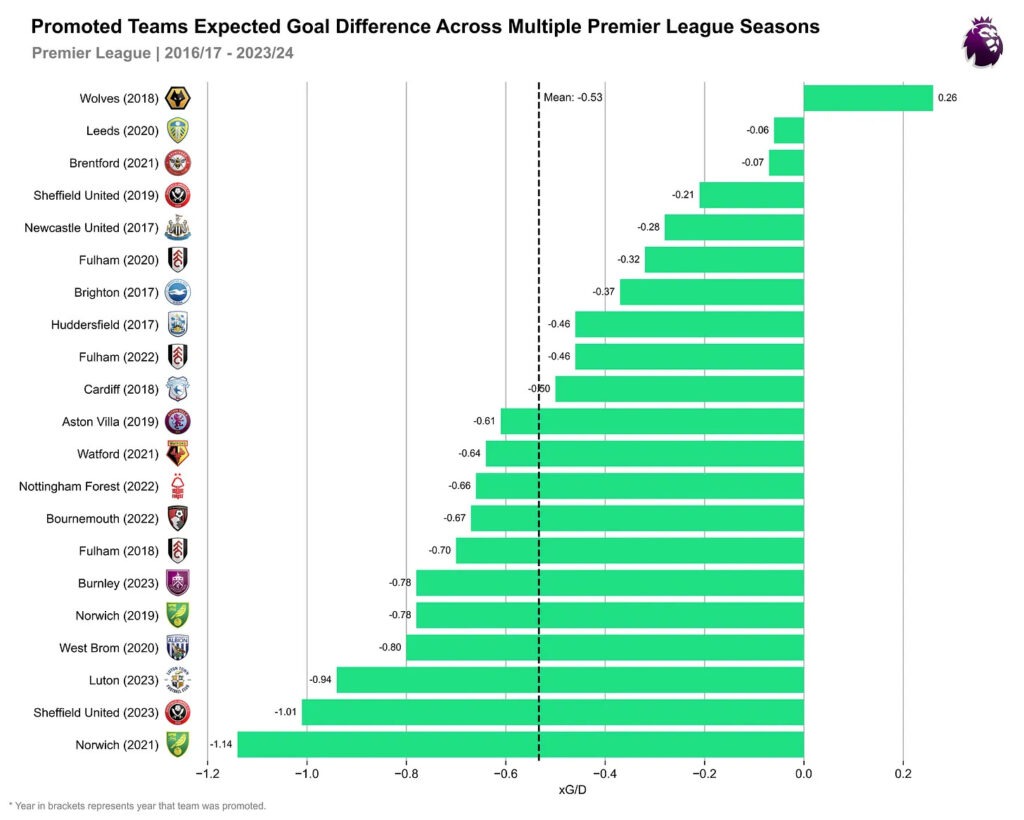
Wolves are clear outlier among recently promoted sides, standing alone as the only team to maintain a positive average expected goal difference (xGD) in their first Premier League season – a remarkable achievement for any newcomer. While several promoted teams have managed top-half finishes, Wolves’ 7th place in 2018 was fully backed by their underlying numbers. What makes their story even more intriguing is that their promotion campaign wasn’t particularly dominant from an xG perspective; in fact, their expected goal difference (xGD) ranked toward the lower end of our sample. Significant investment during that period undoubtedly played a key role in bridging the gap and powering their immediate success at the top level.
At the other end of the spectrum, Daniel Farke’s Norwich side from the 2021/22 season recorded the worst average expected goal difference in the sample, closely followed by Sheffield United and Luton Town from the 2023/24 season. The numbers reflect what many observed on the pitch, these teams struggled significantly, and their underlying metrics offer little to suggest they were simply unlucky. In short, the eye test and the data tell the same story. They just weren’t good enough.
Sign Up For Our Mailing List
Comparing the Changes in Performances
Now, let’s take a closer look at how each team’s expected goals for and against changed between their Championship and Premier League seasons. To ensure a fair comparison across different years, the xG values have been normalised relative to the total league xG in each season – this is done to adjust for the overall “xG climate” at the time. This gives us a clearer picture of how teams adapted (or failed to adapt) to the step up in competition.
On average, promoted teams experienced a 33.49% drop in their normalised expected goals (xG) when moving up to the Premier League – highlighting the significant challenge of creating chances at the top level. Meanwhile, their normalised expected goals against (xGA) rose by 46.48%, meaning they conceded nearly half as many more quality chances per game compared to their time in the Championship. These shifts underline just how steep the step up in competition really is, both offensively and defensively.
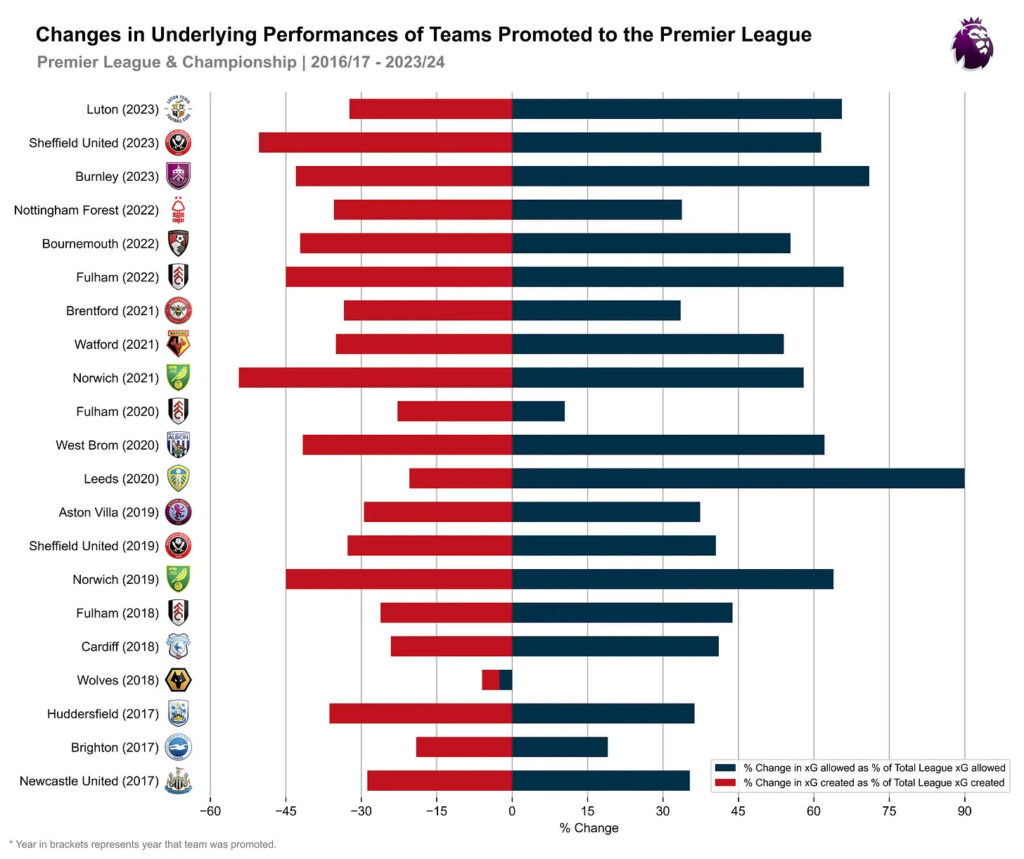
Once again, Wolves emerge as the clear outliers. Their attacking output saw minimal decline after promotion, and remarkably, their defensive metrics actually improved – something that’s rarely seen when teams make the jump to the Premier League. At first glance, this seems difficult to explain. As mentioned earlier, heavy investment certainly played a role but another compelling factor may be Nuno Espirito Santo’s pragmatic,defensively disciplined style. His system – rooted in Portuguese tactical principles – relied on a compact mid-to-low block and quick transitions, a setup that arguably thrived in the underdog role Wolves often played in the top flight.
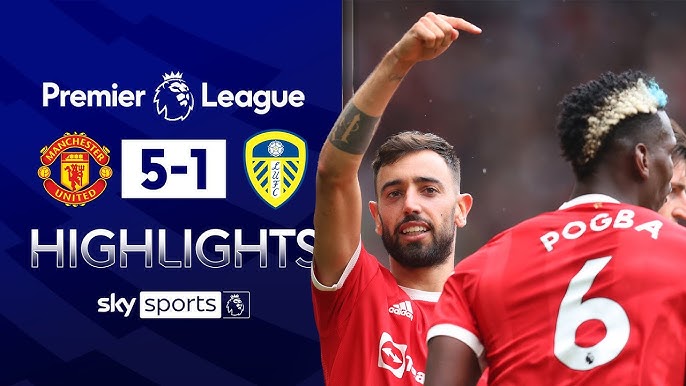
Leeds stand out as outliers in the wrong direction – their expected goals against (xGA) increased by nearly 90% after promotion. In contrast to Wolves, the explanation may lie in Marcelo Biesla’s famously aggressive man-marking system. While it gave Leeds a clear edge in the Championship, where they often had a talent advantage, the approach proved far more fragile in the Premier League. With less margin for error and stronger opponents exploiting individual matchups, their defence often looked exposed. Despite an impressive 9th-place finish, cracks were evident – particularly in games like those against Manchester United, where their intense man-marking was repeatedly pulled apart.
Conclusion
Ultimately, the data only reinforces what supporters have felt for years: the leap from the Championship to the Premier League is less a step and more a chasm. Even the strongest promotion winners quickly find the ground shifting beneath their feet. On average, they create a third fewer chances going forward, while at the same time facing nearly half as many more high-quality chances against. It’s a brutal reality check — the joy of promotion often giving way to the grind of survival. Until the financial playing field is levelled, the story is unlikely to change. The “yo-yo club” has become a permanent fixture of English football — but it doesn’t have to be. Throwing money at the problem is a lazy solution. Survival won’t come from reckless spending sprees; it’ll come from pragmatism. Promoted teams need to adapt, play smarter, and stop trying to beat better sides at their own game.
Sign Up For Our Mailing List
Disclaimer: Data analysis isn’t about capturing every detail—it’s about uncovering meaningful patterns from what’s available. The data used in this study is both robust and thoughtfully selected, offering a reliable foundation for insight. While no dataset is ever truly exhaustive, we aim to be honest and provide insightful interpretation.