Introduction
In today’s game, the most dangerous attacks are not simply built on the individual brilliance of one or two players, but on how well a group of forwards function together. The modern forward is now expected to be multi-skilled—able to dribble, pass, and score—but while having several of these “triple-threat” players in one frontline can be hugely effective, it is not the only formula for success. What matters most is the balance and chemistry between the attackers. A frontline filled only with goal-scorers might lack the creativity or link-up play needed to break down stubborn defences, just as a group of playmakers without a finisher would struggle to convert chances. The strongest attacks often emerge when different qualities are blended into a cohesive unit, with each forward’s strengths complementing the others. Liverpool’s celebrated Mane-Firmino-Salah trio is a classic example of three versatile forwards combining seamlessly, while Eintracht Frankfurt’s 2019 “Magic Triangle” of Jović, Haller, and Rebić showed how players with contrasting styles can come together to devastating effect. In both cases, the key was not just individual talent, but the way the pieces fit together to form a balanced and unpredictable attacking force.

Evaluating Frontlines
To bring the cluster framework discussed in a previous article to life, we took a closer look at forward lines of several teams across Europe from last season and mapped out which clusters their players belong to. We’ve built three point radar charts to capture the average contributions in shooting, passing and carrying for each team’s attacking group. These charts help visualise the level and balance of a team’s attack – Whether it’s built on all-rounders, specialists, or a complementary mix of different profiles.
Los Blancos
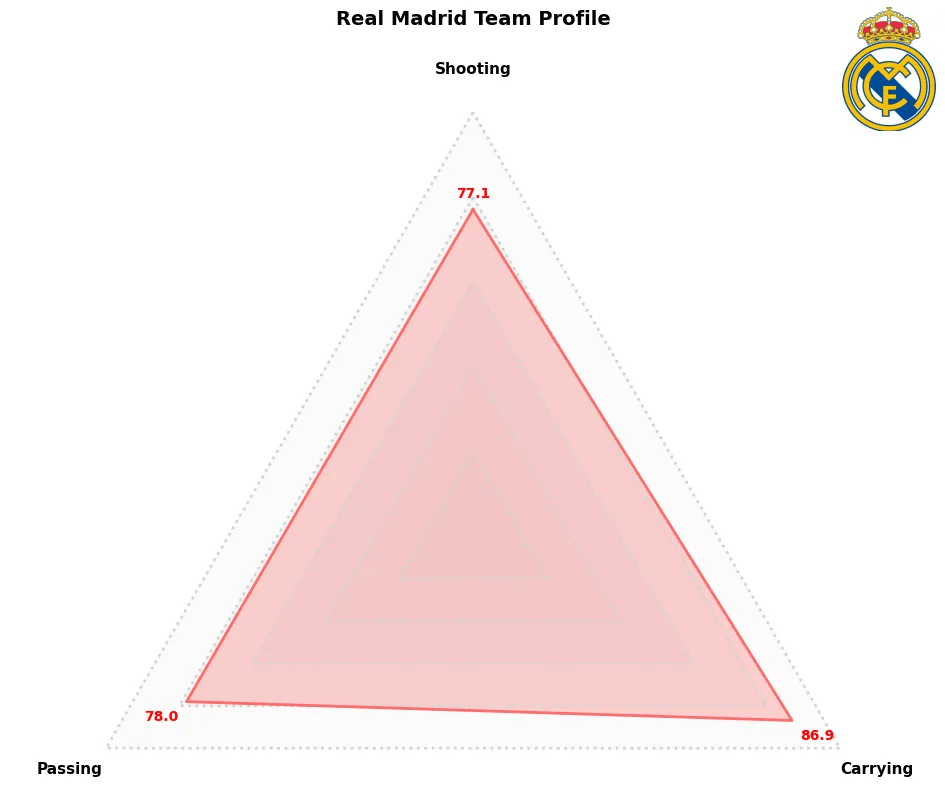
Real Madrid’s frontline embodies the very principle Ian Graham once highlighted, a forward trio that collectively covers all three offensive threats. Their radar chart paints the picture of a well-balanced unit, with carrying ability standing out at an impressive 87th percentile, with shooting at 77th percentile and passing at 78th percentile. This emphasis on ball progression is no surprise, given that all three players are nominally wingers, using their pace and dribbling to drive the team forward.
Blaugrana
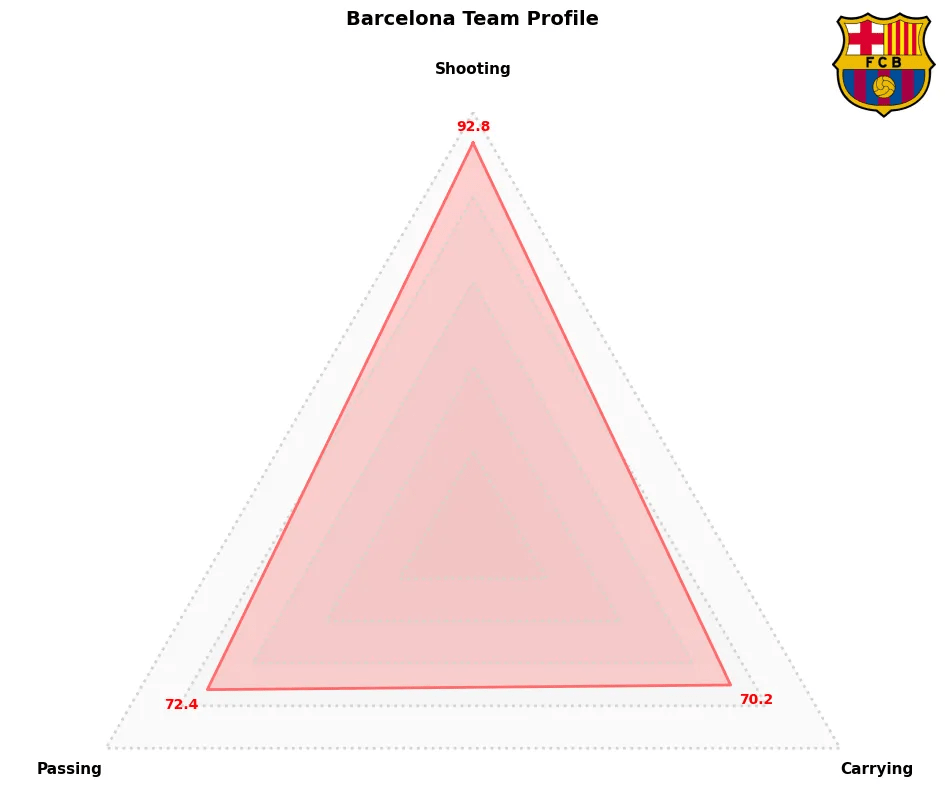
Barcelona had the most potent attack in La Liga last season with 11.37 greater expected goals than Real Madrid. Instead of three all-round forwards like Madrid, Barcelona uses two unicorns wingers alongside Lewandowski, who is primarily a bagsman.
The distinction is evident in the radar chart, their shooting score is impressive in the 93rd percentile, much higher than their passing (72nd percentile) and carrying (70th percentile). It suggests a tactical setup focused on using creative wingers to open up space and opportunities for their prolific goal scorer.
Sign Up For Our Mailing List
The Cottagers
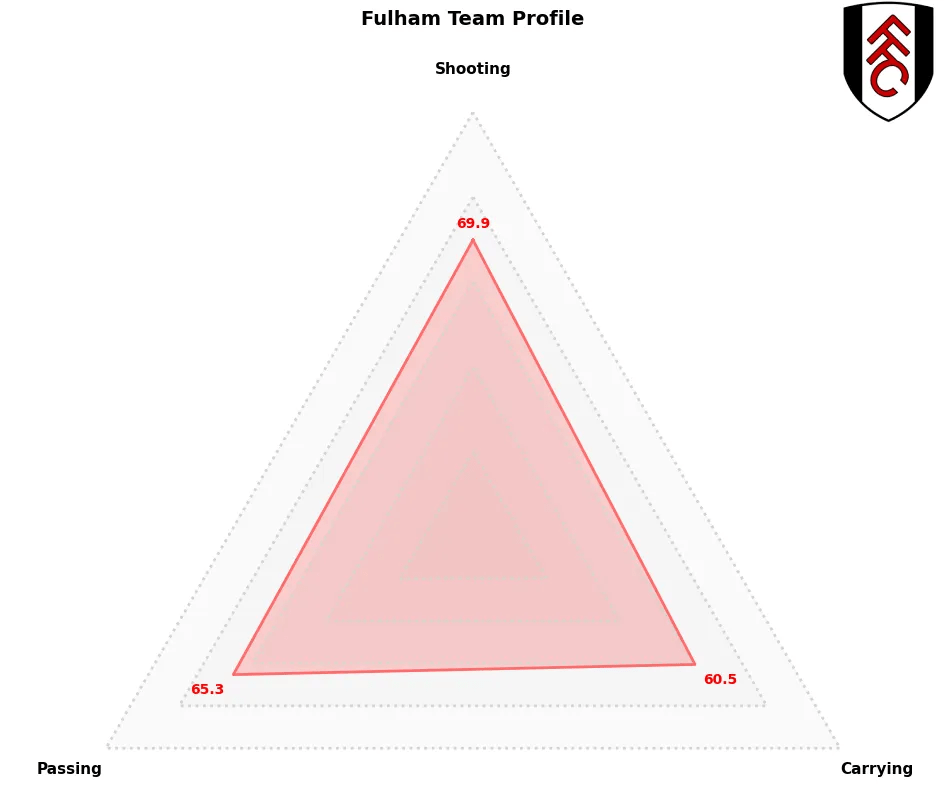
Fulham offers a different kind of attacking balance. They’re not at the level of Barcelona or Real Madrid, which is reflected in their lower overall scores – Shooting at 70th percentile, Passing at 65th percentile and Carrying at 60th percentile. What stands out from their radar chart is how evenly spread their attacking threat is across all three categories.
Interestingly their front line is built on a rotation of four players, each representing a different cluster profile. Jimenez leads the line as a bagsman, while Wilson and Iwobi bring strengths in passing and carrying as ankle breakers. The Adama Traore, perhaps unexpectedly registers as a unicorn. This diversity ensures that, regardless of who partners with Jimenez, Fulham’s attack retains a varied and balanced threat profile.
The Saints
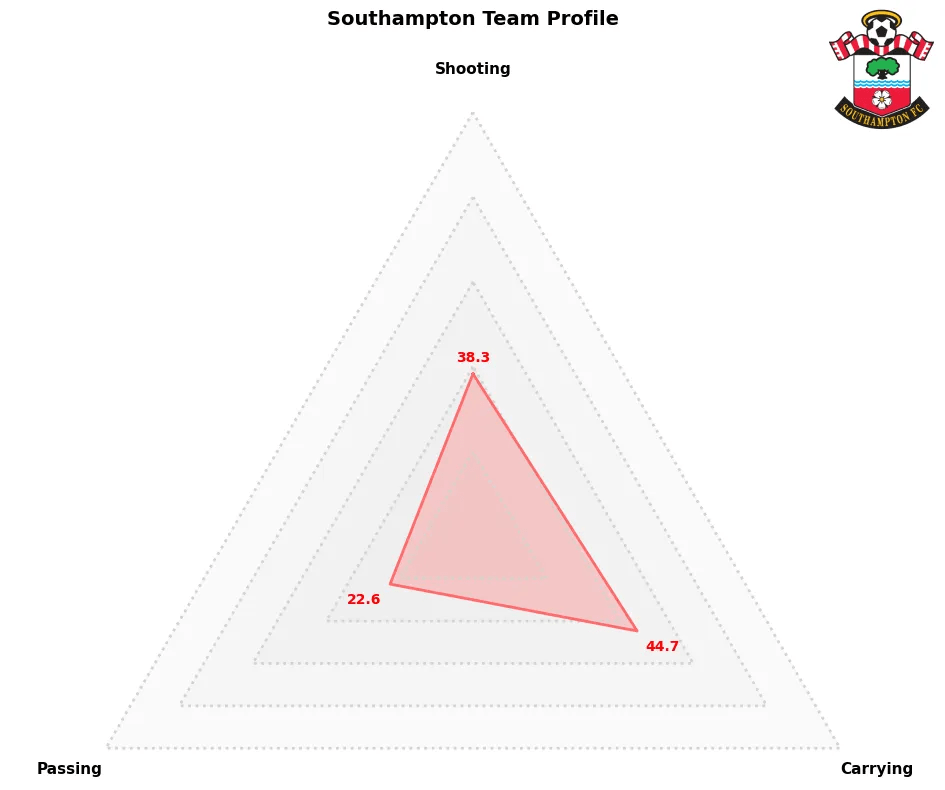
Southampton had one of the weakest attacks in Europe last season. While some of the blame may lie with Russell Martin’s conservative tactics in the first half of the season, the data reveals deeper structural issues. The radar chart shows not just poor overall output – shooting at 38th percentile, passing at 22nd percentile and carrying at 48th percentile – but a real lack of balance between the three attacking threats.
Cameron Archer and Adam Armstrong rotate in the centre forward and wide positions. Archer brings something in terms of shooting, but Armstrong is underwhelming across all areas. On the other hand, young Tyler Dibling showed encouraging signs, particularly in carrying and to a lesser extent in passing. The passing score in the 22nd percentile is alarming and speaks to Ian Graham’s point “If you can’t pass effectively, you can’t progress into dangerous areas”.
Conclusion
.Modern football has shown that there is no universal blueprint for building a top-class attack. Some teams, like Real Madrid, thrive by stacking their front line with all-rounders who can dribble, pass, and score in equal measure, creating a fluid and unpredictable threat. Others, such as Barcelona or even Fulham, have built dangerous attacks by not relying on identical skill sets, but by combining players with complementary strengths that, when meshed together, create balance and variety.
At the other end of the spectrum, Southampton’s struggles highlight what happens when the pieces don’t fit—when player profiles and tactical demands are out of sync, the attack quickly becomes blunt and ineffective. What all this underlines is that there isn’t a single “right” way to assemble a forward line. Instead, the secret lies in balance: whether through versatile stars, cleverly aligned complementary roles, or a mix of threats that keeps defenders guessing, the best attacks are those where the whole is greater than the sum of its parts.
Sign Up For Our Mailing List
Disclaimer: Data analysis isn’t about capturing every detail—it’s about uncovering meaningful patterns from what’s available. The data used in this study is both robust and thoughtfully selected, offering a reliable foundation for insight. While no dataset is ever truly exhaustive, we aim to be honest and provide insightful interpretation.